
Researchers: Ernst Braun & Sarah Steinmann
Analysis of the geometry of water crystals commissioned by NV Dynamized Technologies in September 2016 & July 2019
Process: Digital photographs of 22 drops of crystallized water per sample (distilled/tap water from 3 different countries, i.e., 132 drops of water observed under a microscope at 200x magnification), of which 4 drops per sample are saved, i.e., 24 water crystals. The water is frozen in a Petri dish at -30°C, causing crystals to form at the tip of the ice. The crystals appear at -5°C for 20 to 30 seconds (when the lamp illumination makes the crown of the crystallized water droplet shine).
Objective: To observe the structure of water crystals and compare this structure between different types of water (dynamized and non-dynamized); this method is indicative and illustrative; these experiments do not constitute scientific proof; nevertheless, these observations must be linked to the scientific analysis of "dry residues structured by the energy of water," carried out by Prof. Bernd Kröplin (University of Stuttgart, Institute for Aerospace Thermodynamics, in 2016)
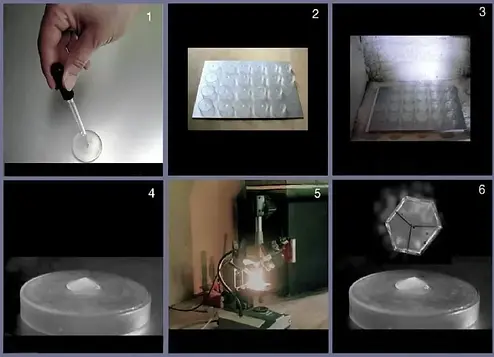
Procedure for creating photos of water crystals
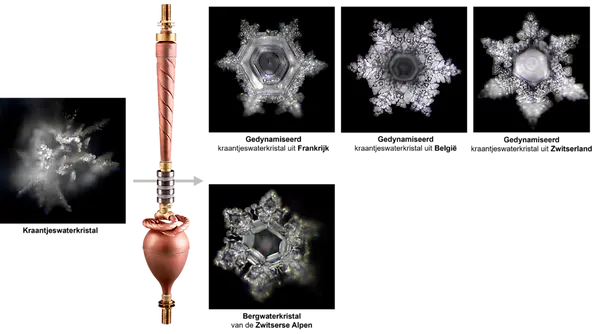
The footprints left by dynamized water are often comparable to those of mountain water!
Comparison of a crystal of untreated tap water> <3 crystals of dynamized water from 3 different countries (Rhode St. Genèse in Belgium, Brens in France & Uttigen in Switzerland): dynamized water often gives beautiful hexagonal water crystals that can be an expression of the energy it contains!
Analysis of the geometric structure of dynamized water:
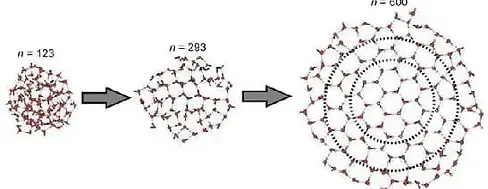
Crystallized and dynamized water often has a hexagonal structure similar to that of natural water that spontaneously springs from its source. This harmonious structure is presented as a simple and complete hexagonal heart (a honeycomb structure, which is the universal structure of the universe) surrounded by six trees structured in a fractal manner (symmetrical, regular, and redundant superstructure). Each water crystal is composed of approximately 600 water molecules connected by hydrogen bonds. In this context, compare the studies of Prof. Mu Shik Jhon on the hexagonal structure of liquid water (a microcluster of six molecules), which he considers the most natural and stable structure of water, capable of storing maximum energy. Conversely, tap water often appears to have a distorted crystalline structure.


Tap water
Dynamised water
A water crystal is made up of 600 H2O molecules; Thomas Zeuch Institut für Physikalische Chemie in Göttingen, Germany vibrational spectroscopy analysis
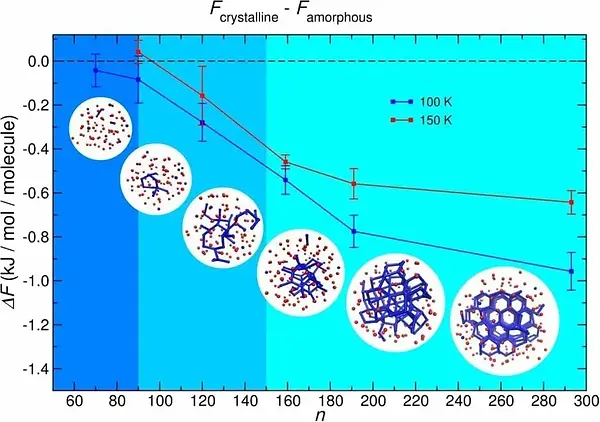
Copyright: Max-Planck-Institut fur Dynamik und Selbstorganisation, D-37077 G Öttingen, Germany; and ¨ ; Department of Chemistry, The University of Utah, Salt Lake City, UT 84112-0850 ( n = number of water molecules)
