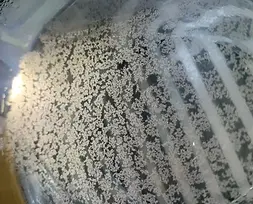
1/ Boiler test (October 2023): Water heated to 60°C and 90°C in identical containers and visual observation of the difference in crystalline structure of the limestone floating on the water surface.
Limescale in undynamized tap water collects in clusters of limestone (which agglomerates) that float on the water surface
Limescale in dynamized tap water appears in the form of a thin pulverized layer that floats on the water and spreads over the entire water surface.
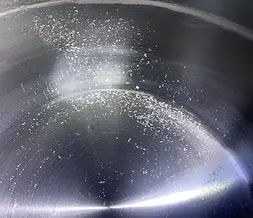
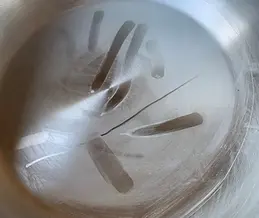
2/ Pan test (October 2023): Water heated to 60°C and 90°C in identical pans and visually observed the difference in crystal structure:
Limescale in undynamized tap water floats on the surface of the water, where it aggregates in clusters (clear water); after evaporation, it settles at the bottom of the pan on a more concentrated surface, making it stickier and more viscous.
Limescale in dynamized tap water, which is suspended, is distributed across the entire surface of the water and also dissolves in the water (the water is no longer transparent). It has a finer, pulverized texture; after evaporation, it settles at the bottom of the pan, spreading over a larger surface area and developing a silky texture (like a fine white powder), with less crust formation, making it easier to remove.

Limescale in non-dynamized water
Limescale in dynamized water

Limescale in non-dynamized water

Limescale in dynamized water

Limescale in non-dynamized water
Limescale in non-dynamized water

Limescale in dynamized water
Limescale in dynamized water
3/ Buildwise test (March 2024)
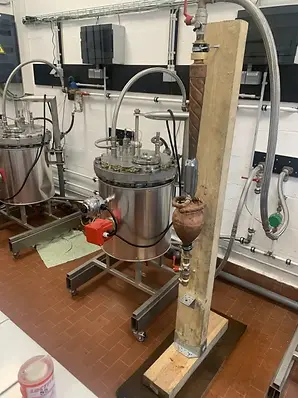
Observation of the variation in the amount of limescale in a boiler/water heater (open circuit: 10 liters drawn every 30 minutes) set at 75°C for 30 days (01/11/2024 to 03/08/2024) in tap water (30°F) dynamized>< non-dynamized; Evacode CC procedure CCN/PN/NBN-917 (see full Buildwise report below)
Observation:
In the boiler with dynamized water, there is 12% less limescale deposits (bottom of the boiler and electrical resistance) because this limescale is pulverized and can therefore be removed more easily:
The limescale that remains around the resistances and on the bottom of the boiler decreases
The Biodynamizer has an effective ability to reduce the formation of limescale
4/ Buildwise test (March 2024)
Observation of the difference in mineralogical structure of limestone (morphology and structure) formed and survived in 2 kettles , one containing dynamized water and the other non-dynamized water; Analysis by electron microscope (SEM) with EDS (“Energy Dispersive X-ray Spectroscopy”); internal procedures SP/MIC/6.05 based on NBN EN 12326-2 (2010) and SP/MIC/6.07 (see full Buildwise report below)
Observation: "The crystals observed on the limescale from the Biodynamizer-treated installation appear locally somewhat more fragmented and show a slightly more chaotic arrangement" (the limescale in non-dynamized water is actually more in the form of small plates in packets, while the limescale in dynamized water is more in the form of a "cauliflower").
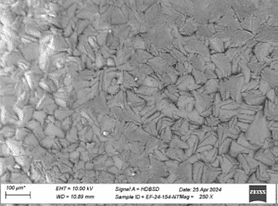
Limescale in non-dynamized water

Limescale in dynamized water
