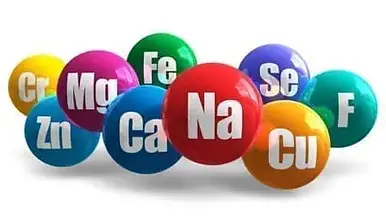
Importance of minerals in drinking water:
Natural water contains inorganic mineral salts, primarily calcium and magnesium (approximately 80%). These minerals can be partially metabolized by the body (intestinal absorption). Studies on this topic estimate this assimilation rate to be between 5% and 25%!
The minerals in natural water account for between 20% and 50% of the Recommended Dietary Intake (RI) for calcium and magnesium* for an individual (for an adult male/female: calcium requirement +/- 900 mg/day, magnesium +/- 400 mg/day)! Calcium and magnesium are therefore beneficial for health. Calcium contributes to bone health and plays a beneficial role in hypertension, cardiovascular disease, and colon cancer. Magnesium is involved in the activation of more than 300 enzymatic systems, combating fatigue, diabetes, and coronary heart failure, as well as osteoporosis. Knowing that the average population has an average calcium deficiency of +/- 40% (average nutritional needs) and even 70% for magnesium, it is therefore essential to drink mineralized water with a mineral content of up to 500 mg/L! * Depending on the mineral content of the water and the age of the people involved. Source: Study on the absorption of calcium and magnesium in natural mineral water, Patrice Fardellone, CHU Amiens, Université Picardie Jules-Verne, 2015; "The mineral elements present in tap water, by contributing to the daily mineral intake necessary for the body's proper functioning, play a clear beneficial role in health. Calcium in water may also play a role in protecting against cardiovascular disease. Calcium's role in the elimination of fats and the regulation of blood cholesterol is also recognized" (source: French Ministry of Health, 2006).
The WHO (World Health Organization) speaks of an “optimum” below 1,000 mg/liter.
In its 1990 and 1995 decrees on the quality of water intended for human consumption, the French High Council for Public Hygiene sets the quantity of dry residues, after drying at 180°C, at a maximum of 1,500 mg/litre.
It is also important to have calcium-magnesium (components of lime) in the water because of the rounder and softer taste of water with mineral salts.
Minerals are restructured

To ensure that water is beneficial to health, it must first be filtered (to remove contaminants), but above all, the minerals must be preserved because they contain the natural synergy of fully metabolized trace elements. Dry residues in water are composed of:
Minerals that are absorbable by the body (between 5% and 25% inorganic minerals) including trace elements
Minerals that cannot be metabolized by the body (between 95% and 75% of inorganic minerals)
The Bioelectronics analysis (cold water) , the water crystal analysis (cold water) and the limestone treatment analysis (heated water) , seem to confirm that the dynamization of water transforms the ionic form of inorganic minerals (i.e. electrically charged ions) present in water into colloidal form (i.e. electrically neutral ions whose structure and size change).
Regarding the inorganic minerals present in dynamized water, we can therefore estimate based on these analyses that these should mainly remain in the intestines and should be removed via the feces rather than via the kidneys-urine!
Metabolism – removal of minerals in drinking water
1/ Untreated tap water, minerals appear:
Mainly in ionic form (electrically charged), namely:
The majority cross the intestinal membrane and are partially metabolized—absorbed ( 5% to 25% of all minerals present in water), depending on the ionic pathways adapted for this purpose. The remainder is excreted through the kidneys/urine.
In minority they remain in the intestine and are evacuated with the feces
Occasionally in colloidal form (for their behaviour, see below)
2/ Dynamized tap water , the minerals would appear:
Mainly in colloidal form (electrically neutral and smaller sizes), including:
A majority would have a size > 50 nm and remain in the intestines and thus be eliminated via the feces
A minority would have a size between 0 and 50 nm and would pass through the intestinal wall via a tunnel effect through an unintended door and be partially metabolized, depending on the individual's needs (from 5% to 25% of all minerals present in water). These would therefore be eliminated via the kidneys/urine.
Occasionally in ionic form (for their behavior, see above)

What is limescale?
All mineralised water (including tap water) containing lime is converted into limescale under the influence of heat, which initially takes the form of aragonite (softer and lime-soluble), which eventually changes into calcite (hard and compact deposits that have caked and hardened in water pipes).
This limescale will settle around the resistances of the boiler water heater (which heats the water up to a maximum of 55 ° C) and will calcify, which will reduce the energy efficiency, but it will also build up in the water pipes in the long term, with the risk of clogging them!
To prevent these problems, it's therefore advisable to treat this lime by changing its mineralogical structure to make it more soluble, preventing pipes from clogging. The lime thus remains in the water but no longer has any drawbacks.
Thanks to the magnetic fields generated by its permanent magnets, the Biodynamizer treats limestone in all distribution water up to a hardness of 40°f (French degree).
For tap water hardnesses above 40°F (very hard water), we therefore recommend installing an additional limescale treatment device, the Bioscaler (in addition to the Biodynamizer ). The Biolimescaler complements the Biodynamizer by changing the mineralogical structure and morphology of lime crystals. Furthermore, the Biolimescaler helps eliminate existing limescale deposits in the pipes.
Water hardness scale: Depending on the geological nature of the soils traversed, the physical and chemical composition of the water will vary. For example, water flowing through calcareous soil will produce water with a high lime content, while water flowing through rocky or sandy soils is considered soft.
-
from 0 to 5° f: very soft water,
from 5 to 15°f: soft water,
from 15 to 25°f: medium-hard water,
from 25 to 40°F: hard water,
> at 40°f: very hard water (in this case, use a suitable limescale treatment such as the Bioscaler!)

Dynamics will change the structure of limestone in the water
The Biodynamizer treats tartar with mechanical and magnetic vortexes by modifying the mineralogical structure and morphology of the limestone crystals (the limestone is pulverized/fragmented, becoming less crusty, which makes it easier to eliminate; see our analyses on limestone treatment with the Biodynamizer ).
The polarization of water molecules caused by magnetization helps reduce the disadvantages of limescale:
The limescale that remains around the resistances and on the bottom of the boiler/heating boiler decreases
The adhesion of limescale in sanitary pipes decreases
Limescale build-up in household appliances (kettle, pans, dishwasher, shower screen, taps) decreases
This is achieved in the Biodynamizer by:
The combination of a fast, turbulent flow and a strong magnetic field enhances the effectiveness of magnetic scaling. The magnetic force potential will be proportional to the potential of the swirling water flow velocities.
Magnetizing with varying powers and orientations (N/SS/N) and magnetizing copper tubes increases the magnetic gradients (= the intensity of the magnetic field lines in space) and also improves the effectiveness of the scaling treatment.
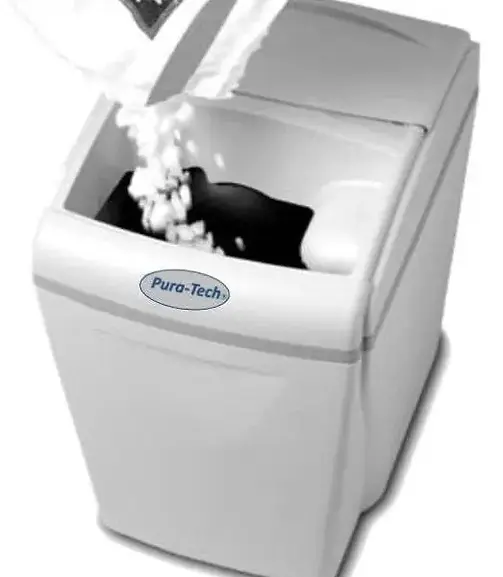
The disadvantages of a water softener:
Does not filter pollutants from the water
Altered taste of water (salty taste due to sodium)
Removes largely valuable minerals (with trace elements)
Does not form a protective scale layer on the internal surface of pipes that will protect against corrosion of galvanized pipes (5°F)
Adds sodium to the water (Na+ = +/- 60% of the salt composition; = +/- 140 mg/L for a reduction of hardness from 30°F to 5°F; recommended sodium consumption: max 200 mg/L (according to the European Drinking Water Directive 98/83) because sodium increases blood pressure (bad for people with heart or kidney conditions)
For regeneration, approximately 100 kg of salt (sodium chloride: Na+Cl-) is used annually; this process produces chlorine dioxide (salt and chlorine from the mains water), which is released into the water and corrodes the galvanized pipes!
Releases brine (limestone + chlorite) to the environment (via sewers)
Discards a lot of water for regeneration (100 L of water per regeneration which takes place every 5 days!)
Risk of bacterial and germ growth in the chemical ion exchange resins if not regularly maintained: after 5 years of operation, mandatory annual maintenance to disinfect the resins! Otherwise, there is a risk of bacteriological contamination of the water by microorganisms!
Maintenance of the most common household appliances

For the iron, use distilled water from the dryer to prevent it from clogging (standard procedure),
For faucets: wipe down the water outlet of your faucets every 15-30 days with a cloth (possibly with white vinegar) (this is standard faucet maintenance), soak the aerators in white vinegar,
The shower head should be soaked in white vinegar every 6 months to descale the holes (this is standard maintenance),
For kettles or coffee makers, the water should not be boiled to 100°C (60-70°C is more than sufficient), as the steam tends to cause limescale to precipitate. Change the water before each heating session and regularly clean the bottom of the reservoir with white vinegar to descale it. This is standard maintenance, depending on the coating on the inside of the appliances.
For dishwashers, standard maintenance: rinse aid (cleaner & degreaser), dishwasher tablets for shiny glasses, dishwasher regeneration salt, regular cleaning of the dishwasher filter; in case of very hard water, use crystallized citric acid,
For shower walls (normal cleaning),
Water jugs, clean the bottom with white vinegar or crystallized citric acid diluted in water,
Washing machines, you can still use fabric softener (but you will need it less).
